Once a family decides to begin music lessons, another question often follows: How long should each lesson be?
Private lessons are commonly offered in 30-, 45-, and 60-minute formats. The right choice depends on the student’s age, attention span, experience, instrument, and goals. Longer lessons are not automatically better. The most effective lesson is one that gives the student enough time to learn without exceeding their ability to stay focused and engaged.
For many younger beginners, 30 minutes is an excellent place to start. Older, more experienced, or highly motivated students may benefit from 45 or 60 minutes.
Related Article
What Age Should Your Child Start Music Lessons?
Learn how attention span, development, and interest can help determine when your child is ready to begin.
Are 30-Minute Music Lessons Long Enough?
A 30-minute lesson is generally the best choice for children under age 10 and for many first-time students. Half an hour provides enough time to introduce new material, review the previous week’s work, address technique, and create a clear practice plan.
Younger students often learn most effectively through shorter, focused activities. Extending the lesson beyond their attention span does not necessarily produce better results. A productive 30-minute lesson followed by regular practice at home is usually more valuable than a longer lesson during which the student becomes tired or distracted.
A 30-minute lesson may be the right choice when the student:
- Is a young beginner
- Is under approximately 10 years old
- Is still developing their attention span
- Has limited time available for practice
- Is exploring an instrument for the first time
- Benefits from short, clearly defined assignments
When Should a Student Take a 45-Minute Lesson?
A 45-minute lesson offers more room to work on several areas without making the session feel overly long. It is often a strong choice for older children, teenagers, adult beginners, and students who have outgrown the pace of a 30-minute lesson.
The additional 15 minutes can make a meaningful difference. The teacher may have time to address technique, music reading, scales, rhythm, and repertoire while still allowing the student to work through questions without feeling rushed.
A 45-minute lesson may be appropriate when the student:
- Can remain focused beyond 30 minutes
- Is working on multiple songs or skills
- Practices consistently between lessons
- Is preparing for a recital or audition
- Wants more time for theory or sight-reading
- Frequently reaches the end of a 30-minute lesson with more to cover
Who Benefits From a 60-Minute Lesson?
Hour-long lessons are usually best for advanced students, serious teenagers, adults with specific goals, and musicians preparing for auditions, performances, competitions, or college programs.
A 60-minute lesson allows the instructor to work in greater depth. The lesson might include technique, theory, sight-reading, ear training, several pieces of music, and detailed performance coaching. It also provides enough time to address complex material without rushing.
However, a full hour can be too demanding for a young beginner. The student should have the attention span, physical stamina, and practice habits needed to use that time productively.
A 60-minute lesson may be beneficial when the student:
- Is an intermediate or advanced musician
- Has ambitious performance goals
- Is preparing for an audition or competition
- Is studying several pieces of music
- Wants substantial work on theory and technique
- Can maintain concentration throughout the entire lesson
Does the Instrument Affect Lesson Length?
The instrument can influence how a lesson is structured, but the student’s needs remain the most important consideration.
Piano
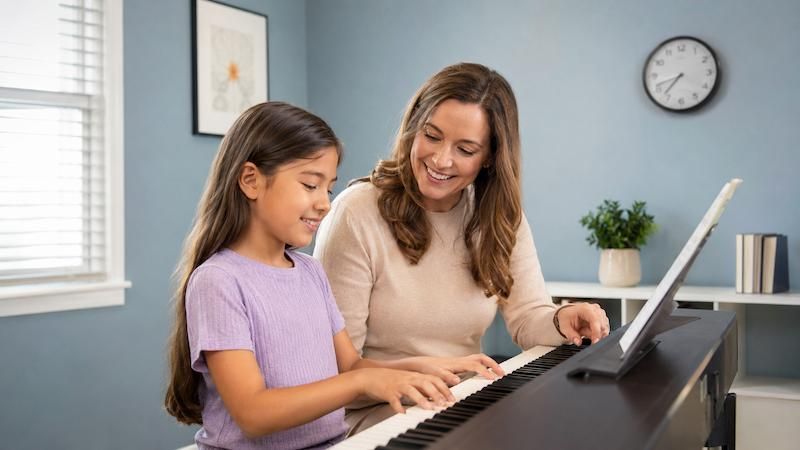
Thirty minutes is usually appropriate for a young piano beginner. As students advance, 45 or 60 minutes provides more time for scales, technique, sight-reading, theory, and multiple pieces.
Guitar and Ukulele
Young guitar and ukulele students can accomplish plenty in 30 minutes. Older students interested in chords, lead playing, improvisation, music reading, and several songs may benefit from 45 minutes.
Voice
Voice lessons usually include warmups, breathing exercises, technique, and song work. Thirty minutes can suit younger singers, while 45 or 60 minutes gives mature students more time to warm up properly and work on repertoire.
Drums
Beginning drummers can use a 30-minute lesson to develop rhythm, coordination, and basic technique. Longer sessions can accommodate reading, rudiments, complete songs, and more advanced coordination work.
Strings, Woodwinds, and Brass
Students learning violin, cello, flute, clarinet, saxophone, trumpet, or another orchestral or band instrument often begin with 30 minutes. Longer lessons become helpful when the student needs additional time for tone, technique, scales, ensemble music, or audition preparation.
Still Choosing an Instrument?
How to Choose the Right Instrument for Your Child
Compare piano, guitar, voice, strings, drums, and woodwinds to find a comfortable starting point.
Attention Span Matters More Than Age Alone
Age is a useful starting point, but children of the same age can have very different learning needs. One nine-year-old may remain completely engaged for 45 minutes, while another may learn more effectively in a focused 30-minute session.
Parents should consider how the child approaches schoolwork, hobbies, and other structured activities. If the student becomes restless toward the end of a lesson, a shorter format may produce better results. If lessons consistently end while the student is still focused and eager to continue, moving to a longer session may be worth discussing with the teacher.
Practice Is More Important Than Choosing the Longest Lesson
Lesson length is only one part of a student’s progress. What happens between lessons matters just as much.
A student taking a weekly 30-minute lesson and practicing consistently will often progress more steadily than a student taking an hour-long lesson without practicing. Lessons provide instruction, correction, and direction. Practice gives the student the repetition needed to turn that guidance into lasting skills.
For younger beginners, several short practice sessions throughout the week are generally more effective than one long session. The teacher can help the family establish realistic expectations based on the student’s age and goals.
Can You Change the Lesson Length Later?
Yes. Families do not need to make a permanent decision when beginning lessons. Many students start with 30 minutes and move to 45 or 60 minutes as their attention span, repertoire, and goals develop.
The teacher will often recognize when the current lesson length is becoming limiting. Parents may also notice that the student regularly has unanswered questions, needs more time to work through music, or remains highly engaged when the lesson ends.
It is equally acceptable to shorten a lesson if the current format is too demanding. The best length is the one that supports productive, enjoyable, and sustainable learning.
Finding the Right Lesson Length
As a general guideline, 30 minutes works well for most young beginners, 45 minutes gives developing students more room to grow, and 60 minutes is best suited to advanced or highly motivated musicians.
Every student is different, however. At Dixboro Music Academy, we help families choose a lesson format based on the student’s age, experience, attention span, instrument, and goals. That recommendation can change as the student progresses.
The goal is not to keep a student in a lesson for as long as possible. It is to provide enough time for meaningful instruction while helping the student leave feeling successful and ready to practice.
Find the Right Music Lesson
Explore lesson options at Dixboro Music Academy and find an instructor, instrument, and lesson length that fit your student.
Book a LessonDixboro Music Academy • 5155 Plymouth Road, Ann Arbor • 734-418-0640